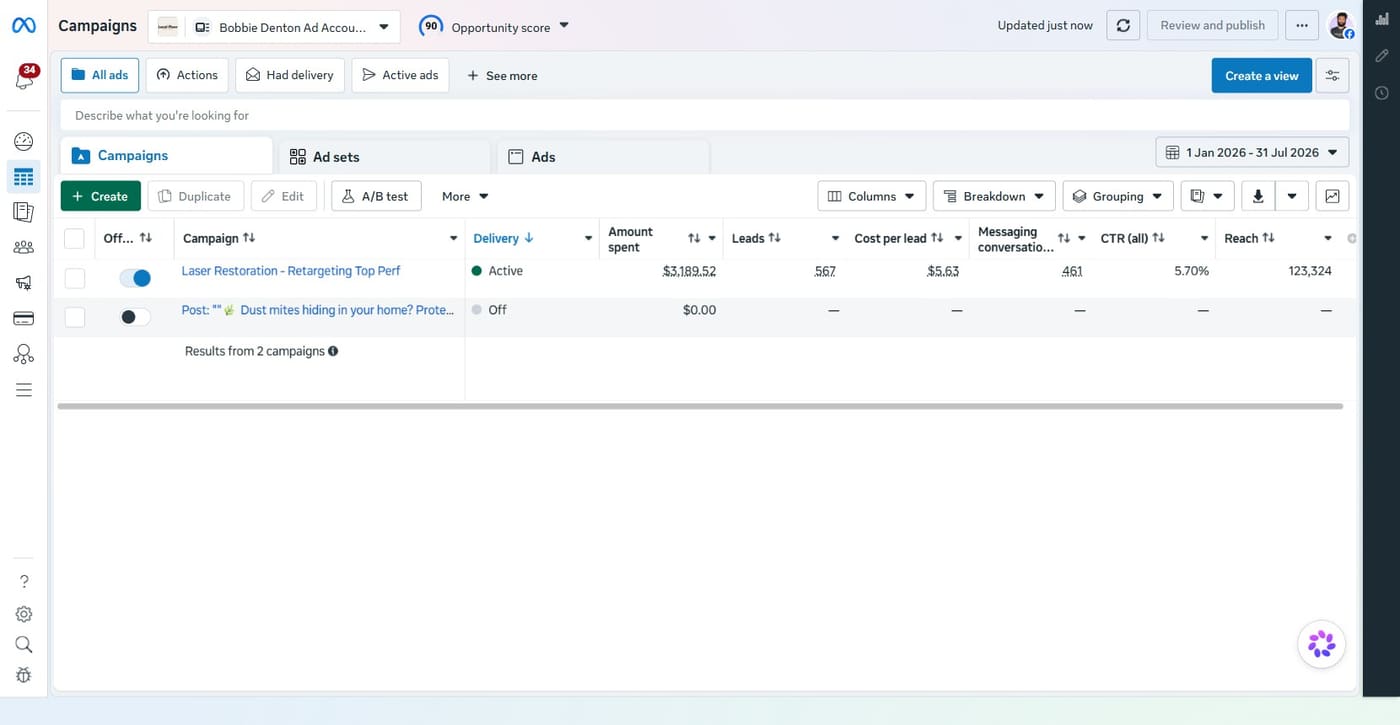
A Meta lead ad campaign for a Knoxville hardwood flooring shop's new laser restoration service spent $3,190 between January and July 2026 and produced 567 lead forms, an average of $5.63 each. The monthly cost ran from $2.92 to $10.77.
An earlier account-level export showed $3,373 for the same period, about $183 more, almost all of it in January and February. We do not know what the extra $183 paid for. Ads Manager lists one other item for the period, a post with $0.00 spent. We use the campaign view because it is the one shown in the screenshots below, and counting the extra $183 against the same 567 leads would give $5.95 per lead.
This is one shop's campaign, so treat it as a single data point. It is a cost per lead, and cost per booked job is a separate number: bookings and revenue are in the shop's CRM, and we did not pull them for this write-up. The spend is Meta ad spend as Ads Manager reports it, and it leaves out management fees, creative production and software.
The shop and the offer
Denton's Hardwood Flooring is an established hardwood contractor in Knoxville, Tennessee, and it already ranked on Google for its main work. The owner bought laser cleaning equipment to sell restoration on floors, furniture, stone and anything else with a finish. Customers had no idea what laser restoration was, and the shop could not answer inquiries fast enough to book them.
The ads were built on before-and-after close-ups and short videos of the laser at work, because the service had to be explained before it could be sold. Our notes describe the campaign as retargeting plus prospecting, optimized for lead forms, with Messenger as a second way to get in touch. The campaign shown in Ads Manager is named "Laser Restoration - Retargeting Top Perf", and we do not have the split between retargeting and prospecting. We built the campaign for the shop, and we chose this account for the post because we can show its numbers. It is not an average of our accounts.
We rotated the creative on a schedule once ad frequency rose, to keep the cost per lead from climbing as the campaign aged. We cannot show how much that helped.
The numbers, month by month
| Month, 2026 | Ad spend | Lead forms | Messaging conversations | Cost per lead | Click-through rate (all) |
|---|---|---|---|---|---|
| January | $1,008.04 | 167 | 115 | $6.04 | 5.80% |
| February | $661.69 | 87 | 88 | $7.61 | 5.77% |
| March | $309.59 | 106 | 73 | $2.92 | 6.49% |
| April | $305.05 | 57 | 59 | $5.35 | 5.71% |
| May | $301.58 | 28 | 30 | $10.77 | 4.41% |
| June | $301.23 | 60 | 38 | $5.02 | 5.36% |
| July | $302.34 | 62 | 58 | $4.88 | 5.69% |
| January to July | $3,189.52 | 567 | 461 | $5.63 | 5.70% |
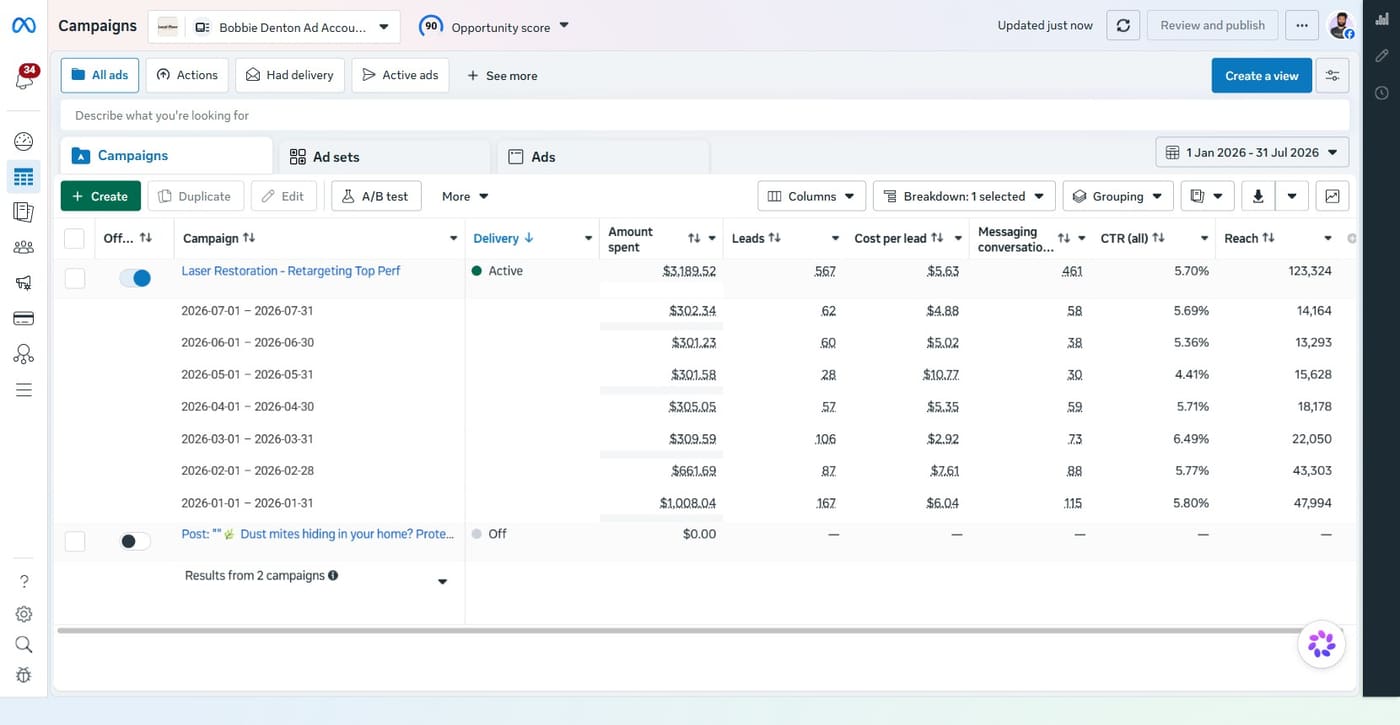
Cost per lead is the spend divided by the lead forms. The 461 messaging conversations are not in that divisor, and we do not know whether they overlap the 567 lead forms.
How the cost varied
Spend fell from about $1,000 in January to about $300 a month from March. The reports we have do not record why. From March the campaign produced between 28 and 106 leads a month, against 167 in January.
Cost per lead stayed between $4.88 and $7.61 in every month except two: March at $2.92 and May at $10.77. Those two months had almost the same spend, $310 and $302, and opposite results: 106 leads in March and 28 in May. March also had the highest click-through rate (6.49%) and May the lowest (4.41%). The data does not show whether the two are related. In the other five months the click-through rate stayed between 5.36% and 5.80% while cost per lead ran from $4.88 to $7.61, and click-through rate (all) counts every click on the ads, whether or not the person then filled in the lead form. The data does not say why May dipped, and one month is a weak basis for judging a campaign.
Taken as two blocks, January and February cost $6.57 per lead ($1,669.73 for 254 leads), and March to July cost $4.86 per lead ($1,519.79 for 313 leads). The reports do not say what changed between the two.
Why cost per lead is only part of the picture
The cost that decides whether ads pay is the cost per booked job: total spend divided by the jobs booked from those leads, compared with the profit an average job earns you. That figure is not in this data. For illustration only, and not Denton's numbers: at $5.63 a lead, a shop that books one lead in ten pays $56.30 per booked job, and a shop that books one in twenty pays $112.60. We also have no verified industry benchmark to compare $5.63 with, so we do not call it good or bad.
Around the leads we set up:
- form submissions that sync into the shop's CRM, tagged by source and by service so the team can see what each person asked for
- an AI chat assistant that gathers details and photos, gives an estimate range and passes qualified leads to the owner
- a text reply for missed calls
We do not have counts for how many leads each step handled. The owner also posted a public comment, shown as an image on the case study. It is undated, and it credits the founder taking over along with a website revamp, so we cannot tie it to this campaign or to any month. It does not say what was turned off:
"Once Jason took over, I started getting so many calls and texts that I literally couldn't keep up! I had to have him turn them off."
Bobbie Jo Denton, Denton's Hardwood Flooring
Questions to ask about any lead source
If you are comparing Meta lead ads with a lead vendor, these questions help you compare like with like:
- Is the lead exclusive to you, or sold to several contractors?
- Do you pay per lead, per click or per booked job?
- How does the vendor define a lead, and will it replace bad ones?
- Do leads reach your CRM in real time?
- Can you see the ad or source behind each lead?
How to read your own numbers
Track cost per lead month by month over at least a quarter, because single months here ranged from $2.92 to $10.77. Watch click-through rate and ad frequency, and note the date each time you change the creative so you can compare before and after. Keep the budget steady long enough to compare months. Then put booked jobs from your CRM next to the ad spend so you can see what a job costs.
About the numbers
All figures come from Meta Ads Manager's campaign view for 1 January to 31 July 2026, in screenshots taken on 16 September 2026, and they appear with the original screenshots on the Denton's case study. Our reporting period is 1 January to 31 July 2026. Earlier and later months are not part of it, and we do not know whether the campaign started on 1 January. The 567 lead forms and 461 conversations are form submissions and opened conversations, and we do not know how many became customers. Spend is shown to the cent here.
If you want a second opinion on your own ad numbers, you can book a call to review them. For the route without ads, see SEO for flooring companies. The shop's website and ad setup is described on our AI website and ads page.